
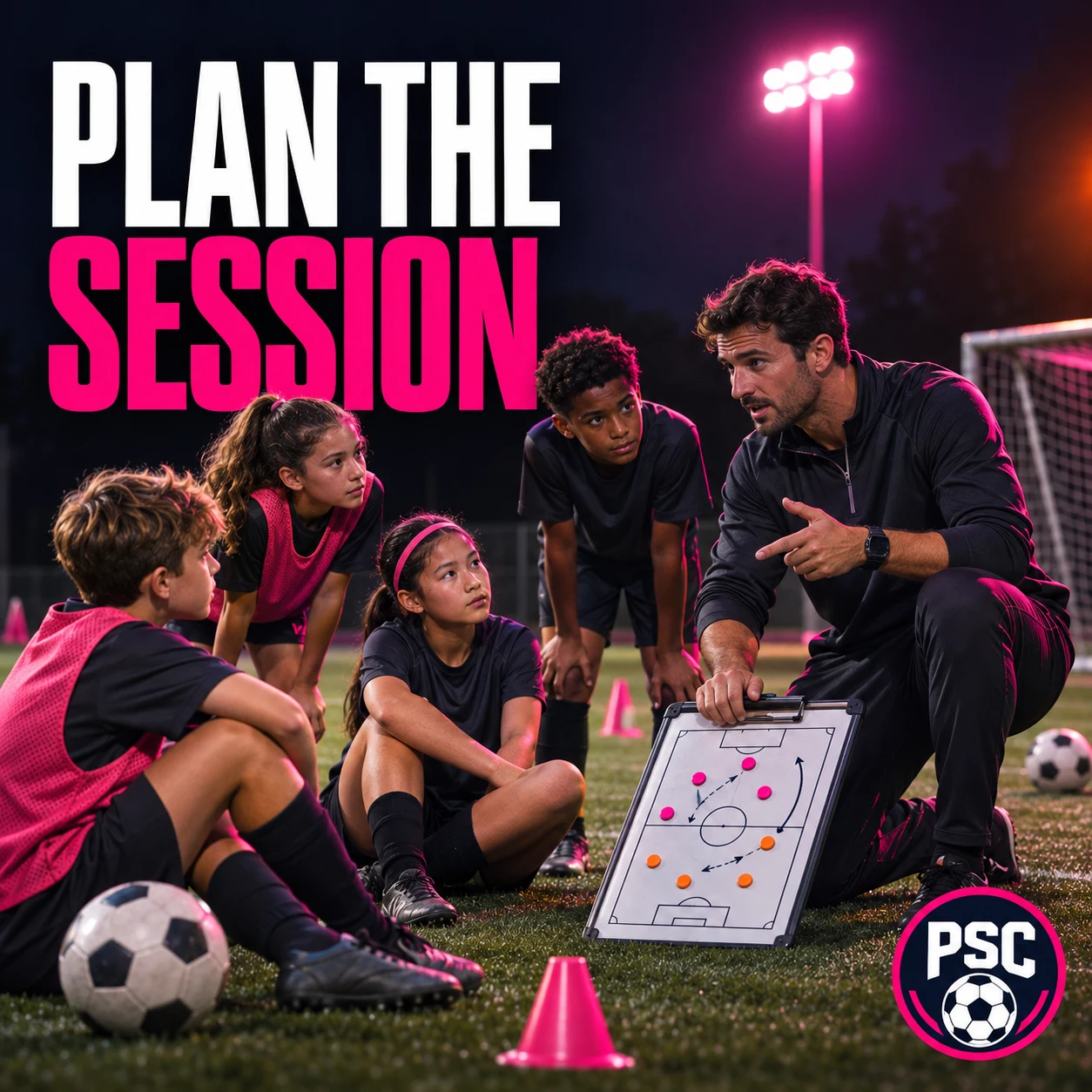
A strong youth soccer practice plan is not a collection of drills squeezed into a time slot. It is a connected learning experience with one clear objective, realistic decisions, enough active playing time, and a game that helps players apply the lesson. This guide gives coaches ready-to-use structures for 60, 75, and 90-minute sessions, plus practical adjustments for different ages, roster sizes, field spaces, and ability levels.
Begin with one clear learning objective
Write the session objective as a behavior players can demonstrate, not a broad topic. Instead of planning a session about passing, decide that players will recognize when to support behind the ball, receive with an open body shape, and play forward when the picture allows it.
One objective helps every activity connect. It also makes coaching interventions shorter because the coach knows exactly what to observe. Players should be able to explain the session theme in simple language before they leave.
Put it into action
- Choose one primary learning objective.
- Define two or three observable player behaviors.
- Remove any activity that does not support the theme.
Use a play-practice-play rhythm
U.S. Soccer promotes Play-Practice-Play as a way to place players in game-like situations, focus the learning, and then let them apply it again. The principle is useful even when a club uses different terminology: begin with soccer, create a focused challenge, and finish with a realistic game.
The opening game shows what players already understand. The middle block lets the coach simplify or repeat an important problem. The final game reveals whether learning transfers when players have more freedom and must make their own decisions.
Put it into action
- Start with a ball and an opponent whenever possible.
- Connect the focused activity to a real game problem.
- Finish with enough game time for players to apply the lesson.
60-minute youth soccer practice plan
Use eight minutes for arrival play and individual ball work, ten minutes for a simple technical introduction, twelve minutes for an opposed activity, twenty minutes for a small-sided game, and ten minutes for a final game plus reflection. Set up the field before players arrive so transitions remain quick.
For younger ages, combine the final two blocks into several short games with quick water breaks. For older players, use the opposed activity to introduce the tactical cue and let the last game provide most of the decision-making.
Put it into action
- 8 minutes: arrival play with a ball.
- 10 minutes: introduce the action and key cue.
- 12 minutes: add an opponent and direction.
- 20 minutes: small-sided game connected to the theme.
- 10 minutes: final game, review, and player reflection.
75-minute youth soccer practice plan
Use ten minutes for arrival play, twelve minutes for activation with the ball, fifteen minutes for a skill-to-decision activity, eighteen minutes for a conditioned game, fifteen minutes for a freer game, and five minutes for reflection. This length gives coaches room for progression without turning practice into a lecture.
The conditioned game should make the theme more likely without dictating every choice. A scoring zone, target player, numerical advantage, or restart rule can focus attention. Remove the condition in the freer game and see whether players continue to recognize the same cues.
Put it into action
- 10 minutes: purposeful arrival game.
- 12 minutes: activation and technical preparation.
- 15 minutes: skill connected to perception and choice.
- 18 minutes: conditioned small-sided game.
- 15 minutes: freer game.
- 5 minutes: reflection and next step.
90-minute youth soccer practice plan
Use ten minutes for arrival play, ten minutes for dynamic activation with the ball, twenty minutes for a technical or tactical block, twenty minutes for an opposed progression, twenty-five minutes for a match-realistic game, and five minutes for reflection and recovery guidance.
A longer session does not require more activities. It requires deeper learning. Keep the objective stable, increase the pressure or complexity gradually, and protect the final game. If players are mentally or physically tired, reduce volume instead of filling every planned minute.
Put it into action
- 10 minutes: arrival play.
- 10 minutes: dynamic activation with the ball.
- 20 minutes: focused technical or tactical learning.
- 20 minutes: opposed progression.
- 25 minutes: match-realistic game.
- 5 minutes: reflection and recovery message.
Adjust the session by age
U6-U8 players need simple pictures, short rounds, many touches, and frequent small games. U9-U12 players can connect technique to scanning, support, pressure, and transition. U13-U18 players can manage longer game phases, position-specific detail, tactical relationships, and more deliberate workload planning.
Age is only one guide. Experience, confidence, maturity, group size, weather, and the weekly match schedule also matter. Keep the challenge slightly above what the players can already solve, then adjust space, numbers, rules, or pressure when the activity becomes too easy or too difficult.
Put it into action
- U6-U8: keep instructions visual and rounds short.
- U9-U12: connect technique to decisions.
- U13-U18: add tactical detail and manage load.
Maximize active learning time
Players improve by playing, perceiving, deciding, and acting. Long lines and long explanations reduce all four. Design multiple small fields, give each player a ball during arrival, use quick restarts, and keep water close to the activity area.
A useful audit is to watch how many players are moving and thinking during any minute of practice. If most are waiting for one player to finish a drill, redesign the activity. Two or three simultaneous groups often create more repetitions and better observation than one large line.
Put it into action
- Avoid lines longer than two players.
- Use stations only when every station has a clear purpose.
- Prepare balls, bibs, goals, and cones before practice.
Coach with questions and short interventions
Ask questions that direct attention to useful information: What did you see before receiving? Where is the space? When should we play forward? What changes when pressure arrives sooner? Give players time to answer through words and actions.
Stop the activity only when the learning value is greater than the lost playing time. A quick individual cue, coaching on the run, a natural break, or a short group intervention can be more effective than repeated full-team stoppages.
Put it into action
- Use one clear question at a time.
- Let players test an answer in the next repetition.
- Balance feedback with uninterrupted play.
Plan for roster size, space, and assistants
Write the expected number of players and a backup plan for fewer or more. A 4v4 game can become 4v3, 5v4, or two 3v3 games without losing the objective when the coach prepares the adjustment in advance.
Give assistants a specific observation task rather than asking them simply to help. One coach might watch the player on the ball while another watches support positions or defensive reactions. Clear staff roles create more consistent feedback and keep every group connected to the same learning goal.
Put it into action
- Prepare a plus-two and minus-two player version.
- Match field size to the behavior you want to encourage.
- Give every assistant one clear coaching responsibility.
Evaluate the practice after the final whistle
Use three questions: Did players spend enough time playing? Did the activities create the intended decisions? Can players now demonstrate or explain the objective? Record one success, one adjustment, and one player who needs follow-up.
Evaluation turns a single practice into a coaching cycle. The next session should build from what players actually showed, not simply move to a new topic because the calendar says so.
Put it into action
- Record one thing to keep and one thing to change.
- Note which players need added challenge or support.
- Use the next session to revisit the same behavior in a new game.
Build progression across the week
When a team trains more than once, connect the sessions. The first practice may introduce a principle in small numbers, the second may apply it in position groups or a larger game, and the match may provide the next observation point.
Avoid making every practice physically and mentally demanding. Consider match timing, school stress, travel, injuries, and total sport participation. A purposeful lighter session can improve readiness more than another high-volume workout.
Put it into action
- Plan the week, not only the day.
- Repeat principles while changing the game problem.
- Adjust volume and intensity around matches and recovery needs.
A simple planning checklist for every coach
Before practice, confirm the objective, player behaviors, field layout, equipment, group sizes, progressions, coaching questions, and backup plan. During practice, watch the players more than the clock. After practice, record what transferred into the game.
The best practice plan is not the most complicated one. It is the plan that keeps players active, makes the learning problem clear, adapts to what happens on the field, and helps every player leave with a meaningful next step.
Put it into action
- Objective: what should players learn?
- Environment: what game will create that learning?
- Observation: what behaviors will the coach watch?
- Adaptation: how will the challenge change?
- Reflection: what happens next?
Frequently asked questions
How long should a youth soccer practice be?
Practice length depends on age, experience, schedule, weather, local rules, and the total weekly load. Many coaches use about 60 minutes for younger players, 75 minutes for developing players, and up to 90 minutes for older youth teams. Quality and active playing time matter more than simply making the session longer.
What should every youth soccer practice include?
Every practice should include a clear objective, active play with the ball, decisions under realistic pressure, age-appropriate coaching, a game that applies the theme, hydration opportunities, and a short reflection or next step.
How much of soccer practice should be game-based?
A substantial portion should allow players to perceive, decide, and act in opposed situations. The exact percentage varies, but coaches should protect meaningful game time and use unopposed activities only when they help players perform the action more successfully in the game.
How do I plan soccer practice for a large group?
Divide the group into smaller games, create parallel fields, reduce waiting, prepare versions for different numbers, and assign assistant coaches specific responsibilities. Keep every group connected to the same learning objective.
How often should youth soccer teams practice?
Frequency depends on age, competition level, season, other sports, school demands, and recovery. Coaches should plan the full week and avoid adding sessions that reduce enjoyment, sleep, health, or match readiness.
Turn learning into action.
Choose one idea from this article and apply it during the next 48 hours.