
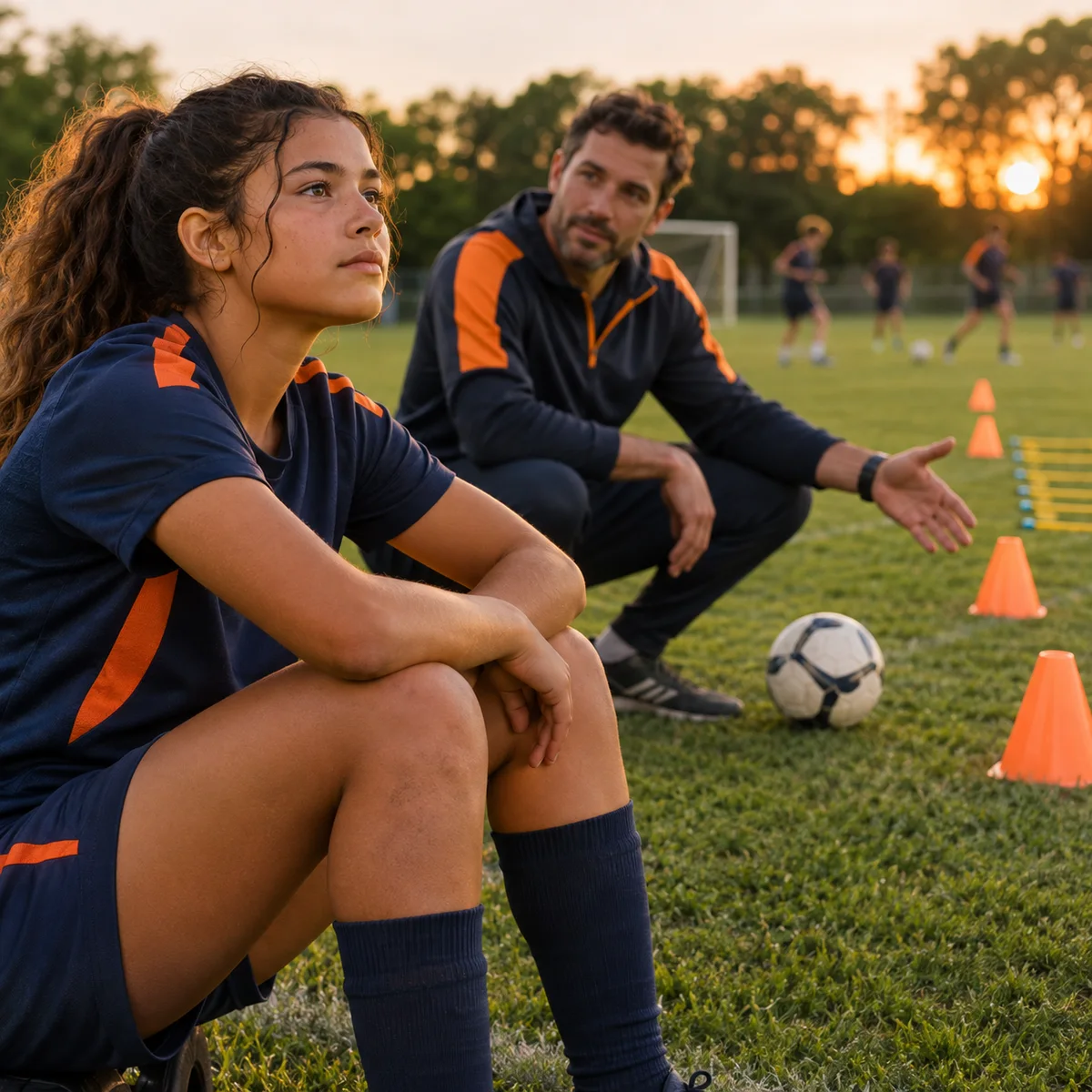
A youth soccer player can train regularly, care deeply, and still feel stuck. The first touch does not look sharper. Game decisions do not feel faster. Confidence drops, extra practice becomes frustrating, and families begin wondering whether the player has reached a limit. Most development plateaus are not proof that a child lacks talent. They are signals that the current learning process needs to change. This guide explains ten common reasons youth soccer players stop improving and provides practical ways for players, parents, and coaches to create progress again.
1. Training has become repetition without a purpose
Repetition supports skill development only when the player knows what is being improved. A player can complete hundreds of touches while repeating the same poor body position, rushed movement, or limited decision pattern.
Give each activity a clear purpose. Instead of saying, practice passing, define the target: receive across the body, scan before the ball arrives, play the next pass with the correct foot, or improve accuracy while moving.
Put it into action
- Choose one technical detail for each activity.
- Measure quality before adding speed.
- Stop and reset when repetitions become careless.
2. The player practices skills without decisions
Unopposed drills can help players learn a movement, but soccer performance depends on reading pressure, space, teammates, opponents, and time. A technique that works around cones may disappear when a defender creates uncertainty.
Add realistic information to training. Use a defender, a direction, a target, a time limit, or two possible actions. The player should have to notice something and choose, not only complete a memorized pattern.
Put it into action
- Progress from isolated technique into a small-sided game.
- Give the player at least two realistic options.
- Ask what information influenced the decision.
3. The goals are too vague or too large
Goals such as get better, make the top team, or become a college player may inspire effort, but they do not tell a player what to do today. When progress is difficult to see, motivation can fall even when learning is happening.
Translate long-term ambition into observable actions. A midfielder might scan twice before receiving. A winger might attack the defender's front foot. A goalkeeper might communicate before the pass enters the defensive third. Review the behavior for several weeks before changing it.
Put it into action
- Choose one primary goal for four to six weeks.
- Describe the goal as an action the player can repeat.
- Track examples from training and games.
4. Feedback is either missing or overwhelming
Players need useful information, but more feedback is not always better. Constant correction can make a player dependent on instructions and afraid to experiment. No feedback can leave the player repeating the same habits without understanding why progress has slowed.
Effective feedback is specific, timely, and limited. Start with what worked, identify one adjustment, and give the player another opportunity. Questions such as what did you see or what could you try next help develop independent thinking.
Put it into action
- Correct one priority at a time.
- Allow another attempt immediately after feedback.
- Use questions to strengthen player ownership.
5. The training challenge no longer matches the player
Improvement slows when training is consistently too easy or too difficult. Easy work may look successful without creating adaptation. Excessive difficulty can produce rushed actions, frustration, and survival habits rather than learning.
Adjust one variable at a time. Change the space, pressure, speed, number of touches, distance, or decision options. The right challenge allows success but requires attention, problem-solving, and repeated adjustment.
Put it into action
- Look for effortful success, not perfect comfort.
- Increase pressure gradually.
- Simplify the task when quality completely disappears.
6. Physical growth has temporarily changed coordination
Youth players do not develop in a straight line. Growth spurts can affect balance, timing, speed, mobility, and confidence. A player who suddenly looks less coordinated may be adapting to a changing body rather than losing ability.
Keep technical work patient and protect the player's identity during this period. Movement quality, strength, mobility, sleep, nutrition, and recovery matter, but programs should remain age-appropriate and guided by qualified professionals when needed.
Put it into action
- Do not label temporary awkwardness as lost talent.
- Allow time for coordination to adjust.
- Monitor pain, fatigue, and workload carefully.
7. Fatigue is limiting learning and performance
More training is often the first response to a plateau, but an overloaded player may need recovery rather than another session. Team practices, matches, private training, school, travel, and poor sleep can combine into physical and mental fatigue.
Review the complete week. Protect sleep, recovery days, hydration, nutrition, and time away from structured soccer. A rested player can learn, adapt, and compete more effectively than a tired player collecting extra hours.
Put it into action
- Count every organized activity in the weekly workload.
- Schedule at least one genuine recovery period.
- Reduce volume before assuming motivation is the problem.
8. Confidence has changed the player's choices
A player in a confidence slump may stop turning, avoid the weak foot, release the ball too quickly, hide behind defenders, or choose only safe actions. The technical ability may still exist, but fear of mistakes limits its use.
Rebuild confidence through evidence. Create manageable challenges, recognize brave decisions, and review specific successful actions. Do not promise that every performance will be good. Help the player trust preparation and respond constructively when a mistake occurs.
Put it into action
- Praise useful courage, not only successful outcomes.
- Use video or reflection to collect evidence of progress.
- Choose one brave action for the next game.
9. The player is training everything instead of the priority
Players can collect drills from coaches, social media, teammates, and apps until the week contains a little of everything. Variety can be enjoyable, but random work makes it difficult to create enough focused repetition for a meaningful change.
Use game evidence to select the priority. Identify one recurring situation, define the technical and decision details involved, and build a short training block around it. Keep supporting skills in the schedule without allowing them to distract from the main goal.
Put it into action
- Select the priority from real match patterns.
- Use a four-week training block.
- Review whether the skill appears more often in games.
10. Adults are measuring progress only through results
Goals, assists, wins, team selection, and playing time are visible, but they do not tell the complete development story. A player may improve scanning, positioning, communication, defensive recovery, weak-foot use, or decision speed without an immediate statistical reward.
Parents and coaches should notice process indicators. Is the player receiving with better body shape? Recognizing pressure earlier? Making more purposeful off-ball runs? Responding better after mistakes? These changes often appear before larger results.
Put it into action
- Track two or three observable behaviors.
- Compare the player with their previous habits, not another child.
- Celebrate learning that transfers into the game.
A four-week plan for breaking a soccer development plateau
Week one should identify the pattern through observation, reflection, and coach feedback. Week two should isolate the key technical detail and introduce simple decisions. Week three should add realistic pressure and game-like situations. Week four should evaluate transfer during training and matches.
At the end of the block, keep the goal, adjust the challenge, or choose a new priority based on evidence. Progress may appear as greater consistency, earlier recognition, better choices, improved confidence, or a smaller gap between training and matches.
Put it into action
- Write one clear development question.
- Choose one behavior to observe each week.
- Use short purposeful sessions instead of panic training.
- Review progress with the player, coach, and game evidence.
When a plateau may require additional support
A temporary plateau is normal. Additional support may be useful when pain persists, motivation changes significantly, anxiety affects daily life, the player appears exhausted, communication with the coach has broken down, or the training environment no longer fits the player's needs.
The next step may be a calm coach conversation, a medical evaluation, workload adjustment, position-specific support, or a healthier development environment. The goal is not to remove every challenge. It is to make sure the challenge remains safe, purposeful, and connected to the player.
Put it into action
- Listen to the player's experience before deciding.
- Seek qualified medical help for persistent pain or injury concerns.
- Change the plan before concluding that the player cannot improve.
Turn learning into action.
Choose one idea from this article and apply it during the next 48 hours.