
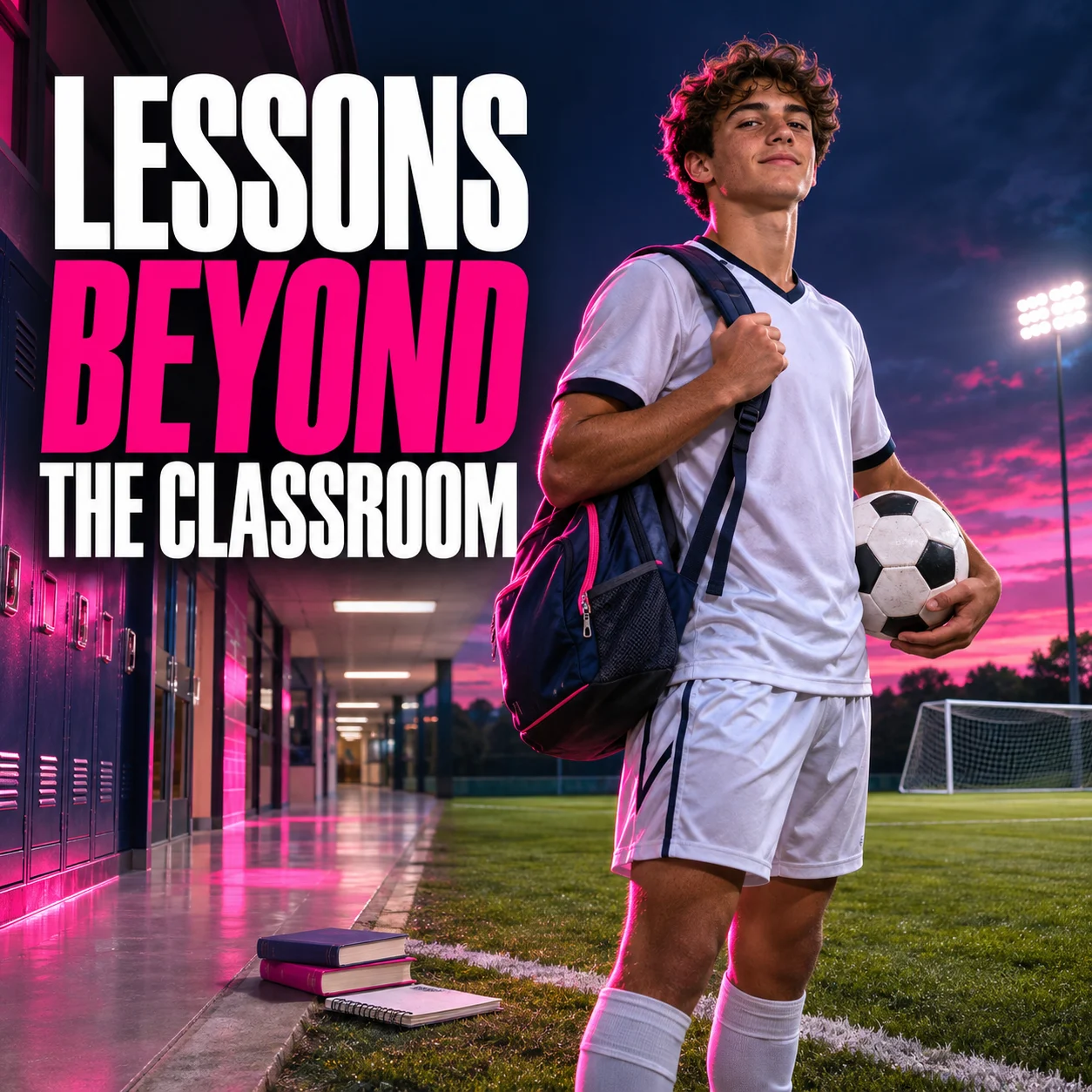
Schools give children essential academic knowledge, structure, and opportunities to think. Sports give many of those lessons a living laboratory. On a soccer field, children must make decisions with limited time, work with people who are different from them, respond to mistakes, manage emotions, communicate, prepare, compete, and accept that effort does not guarantee the outcome. Education and sports should not compete for importance. Together, they can prepare young people for the realities of work, relationships, leadership, health, and adulthood.
Schools and sports develop different parts of the same child
The classroom helps children read, write, calculate, research, question, create, and understand the world. Soccer adds a setting where knowledge and character must be applied under pressure, in public, with teammates, opponents, rules, fatigue, and unpredictable outcomes.
A child needs both intellectual development and practical experience. The strongest education connects what students learn with how they behave, decide, cooperate, and recover when life becomes difficult.
1. How to handle failure without becoming a failure
A missed penalty, lost game, poor tryout, or difficult performance gives immediate feedback. The player can blame, hide, quit, or learn. Soccer teaches that a failed action is an event, not an identity.
Schools can reinforce this lesson by allowing revision, reflection, and improvement after mistakes rather than treating every result as a permanent label.
Put it into action
- Separate the result from the person.
- Ask what can be learned.
- Choose the next useful action.
2. How to work with people you did not choose
Players do not select every teammate, coach, referee, or opponent. They must cooperate with different personalities, abilities, backgrounds, communication styles, and goals.
Adult life works the same way. Students benefit from learning how to contribute to a group without demanding that everyone think, speak, or behave exactly as they do.
Put it into action
- Respect different roles.
- Communicate clearly.
- Focus on the shared objective.
3. How to communicate under pressure
Soccer requires brief, useful communication while the situation changes. Players call for the ball, warn teammates, organize space, ask questions, and repair misunderstandings.
Schools can teach communication as more than presentations and essays. Children need practice listening, disagreeing respectfully, asking for help, giving feedback, and speaking when something is wrong.
Put it into action
- Be clear and specific.
- Listen before responding.
- Match the message to the moment.
4. How to lead without having a title
A captain wears an armband, but leadership appears in many forms. A player can organize equipment, encourage a teammate, raise the training standard, respond calmly, or take responsibility after a mistake.
Children should learn that leadership is behavior, not popularity or authority. Schools and teams can create small, rotating opportunities for every child to serve and influence others.
Put it into action
- Model the standard.
- Help before being asked.
- Take responsibility without seeking attention.
5. How to follow before trying to lead
Players must understand a coach’s plan, respect team rules, learn a role, and contribute to something larger than personal preference. Following well is not weakness. It is a form of discipline and trust.
Students also need to evaluate instructions thoughtfully, ask useful questions, and complete responsibilities before expecting greater independence.
Put it into action
- Understand the purpose.
- Carry out the role reliably.
- Ask questions at the appropriate time.
6. How to make decisions with incomplete information
A soccer player never has perfect information. Teammates move, opponents press, the ball travels, and time disappears. The player must scan, identify options, decide, and adapt.
Many school assignments reward the one correct answer. Life often requires choosing among imperfect options. Students benefit from scenarios, projects, debates, and sports that make them reason through uncertainty.
Put it into action
- Look before acting.
- Choose based on the available picture.
- Adjust when new information appears.
7. How to control emotions without ignoring them
Players experience nerves, anger, excitement, embarrassment, disappointment, and pride. Emotional control does not mean feeling nothing. It means recognizing an emotion and choosing a response that still helps the team and the player.
Schools should give students language and routines for managing emotions, conflict, stress, and recovery. These are learnable skills, not personality traits a child either has or lacks.
Put it into action
- Name the emotion.
- Use a short reset.
- Choose behavior that supports the next step.
8. How to prepare before the important moment
Games reveal habits built during ordinary days. Players learn to pack equipment, arrive on time, eat and sleep responsibly, understand the plan, warm up, and prepare mentally.
Preparation is a transferable life skill. Students can learn how to break large tasks into smaller actions, organize materials, plan backward from a deadline, and avoid relying on last-minute panic.
Put it into action
- Plan backward from the event.
- Prepare materials early.
- Repeat simple routines.
9. How to receive feedback without losing confidence
Coaching asks a player to hear what needs improvement while still believing progress is possible. Useful feedback is specific, actionable, and connected to a clear standard.
Schools and sports should teach children how to receive feedback, ask clarifying questions, test a change, and separate correction from rejection. Adults also need to deliver feedback without humiliation.
Put it into action
- Listen for the action, not only the emotion.
- Ask what improvement looks like.
- Try the change before judging it.
10. How to be responsible to other people
When a player arrives unprepared, stops recovering defensively, or ignores the plan, teammates carry the consequence. Soccer makes responsibility visible.
Children need experiences where their contribution matters to a group. Team projects work best when roles, deadlines, accountability, and reflection are genuine rather than symbolic.
Put it into action
- Know who depends on your work.
- Complete the small responsibilities.
- Own mistakes without excuses.
11. How to compete without disrespect
Competition can teach courage, preparation, focus, and respect. The opponent is not an enemy. The opponent creates the challenge that allows both sides to test themselves.
Schools can teach healthy competition by separating ambition from humiliation, celebrating improvement, enforcing integrity, and helping students respond well to both winning and losing.
Put it into action
- Compete fully within the rules.
- Respect the people creating the challenge.
- Win with humility and lose with perspective.
12. How to delay gratification
Players may train for months before earning a larger role, improving the weaker foot, reaching a fitness goal, or seeing a skill transfer into games. Progress is often slower than motivation wants it to be.
Children benefit from long-term projects and goals that require consistent action without constant rewards. Adults can praise the process without promising that effort always produces the desired outcome.
Put it into action
- Choose a meaningful long-term goal.
- Track small behaviors.
- Review progress without demanding instant results.
13. How to manage time and priorities
Student-athletes balance school, training, games, travel, sleep, meals, friendships, and family. They learn quickly that saying yes to everything is not sustainable.
Schools should teach practical planning, calendars, priorities, rest, and the cost of overcommitment. Time management is not filling every hour. It is deciding what deserves attention and protecting recovery.
Put it into action
- List fixed commitments first.
- Schedule important work before urgency arrives.
- Leave space for sleep and unstructured time.
14. How to care for the body
Sports can help children understand movement, strength, coordination, nutrition, hydration, sleep, recovery, pain, and injury prevention. The goal is not to create fear or obsession. It is to build basic health literacy.
Schools should give students practical knowledge about lifelong movement and wellbeing, not only short units that end when physical education class ends. Individual medical needs should always follow qualified professional guidance.
Put it into action
- Learn the difference between effort and concerning pain.
- Treat sleep as part of performance and health.
- Build movement habits that can continue beyond competition.
15. How to belong to something larger than yourself
A team asks players to contribute even when they are not the star. They celebrate someone else’s success, accept roles, represent a group, and learn that belonging includes responsibility.
Schools can build belonging through teams, clubs, service, arts, mentoring, and community projects. Children need places where they are known, needed, and expected to contribute.
Put it into action
- Notice the work of others.
- Contribute without needing the spotlight.
- Protect the culture you want to belong to.
What schools should teach more directly
Every student would benefit from practical learning in communication, emotional regulation, conflict resolution, financial literacy, digital judgment, health, time management, career exploration, teamwork, leadership, civic responsibility, and how to ask for help.
These topics do not need to replace reading, mathematics, science, history, or the arts. They can be woven into academic work, advisory programs, sports, clubs, projects, and real community experiences.
Put it into action
- Connect knowledge to real decisions.
- Let students practice, not only memorize.
- Include reflection after successes and failures.
- Create multiple ways to lead and contribute.
Sports do not teach automatically
Sports can teach powerful lessons, but participation alone does not guarantee character. A negative environment can also teach fear, selfishness, dishonesty, exclusion, or that winning excuses harmful behavior.
The quality of coaching, parenting, team culture, and reflection determines what children take from the experience. Adults must intentionally model the values they want sports to develop.
Put it into action
- Praise behaviors that match the team’s values.
- Address disrespect even when the team wins.
- Give every player dignity and a meaningful role.
How parents and coaches can make the lessons visible
After a meaningful moment, ask a short question: What did you learn about preparation, communication, leadership, or response? Avoid turning every ride home into a lecture.
Help children name the skill and transfer it. A player who learns to reset after a mistake can use the same routine after a difficult test, conflict, interview, or presentation.
Put it into action
- Ask before explaining.
- Connect one soccer lesson to one life situation.
- Let the child describe the meaning in their own words.
- Keep reflection brief and honest.
The goal is an educated, capable, healthy person
Most young players will not become professional athletes, and that does not reduce the value of sport. The lasting return can be a person who communicates, prepares, collaborates, handles setbacks, cares for the body, and contributes to a community.
Soccer is not a substitute for school, and school is not a substitute for lived experience. When educators, coaches, and parents work together, children gain both knowledge and the ability to use it.
Turn learning into action.
Choose one idea from this article and apply it during the next 48 hours.
Open the Complete Guide →