
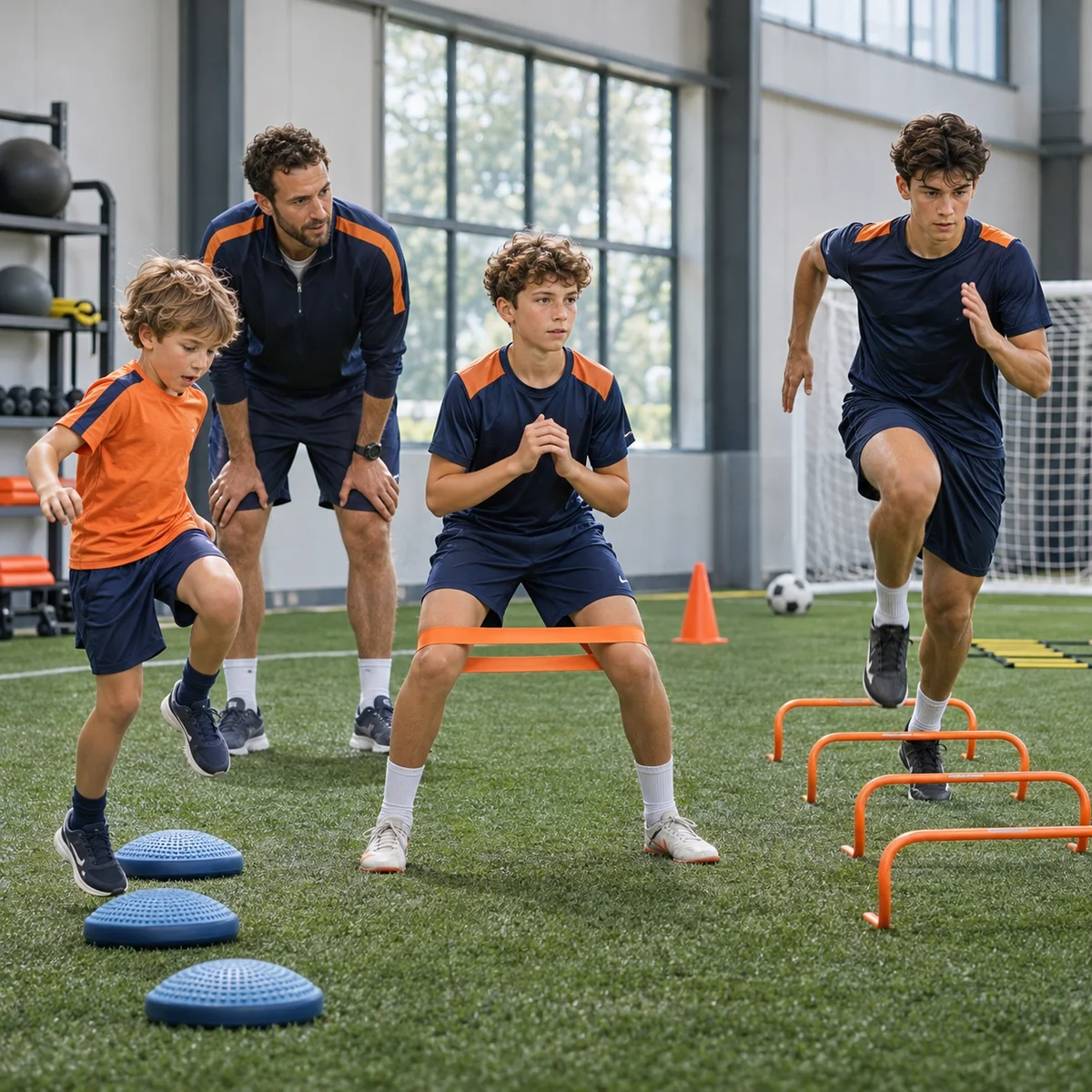
Parents and coaches often ask for the right age to begin strength training, conditioning, speed work, and plyometrics for soccer. There is no single birthday when every player becomes ready. Readiness depends on the child's ability to listen, control basic movements, train safely, recover well, and enjoy the process. The most effective pathway begins with playful movement, then gradually adds structure, resistance, speed, jumping, and soccer-specific conditioning as technique and maturity improve. This age-by-age guide explains what to introduce, what to delay, and how to make athletic development support the player's soccer journey.
The short answer: start with movement, then earn progression
Children can begin learning age-appropriate strength, speed, and landing skills as soon as they can follow directions and control their bodies. For many children, that may be around ages seven or eight, but age alone is not the test. Early training should look like supervised movement education, not adult bodybuilding or exhausting fitness sessions.
Strength training can include bodyweight squats, crawling, pushing, pulling, carrying, bands, and light resistance. Speed training can mean short playful races with full recovery. Plyometrics can begin as simple hopping, skipping, and learning to land softly. Conditioning for young players should mostly come through active play and soccer games. Load, complexity, intensity, and specialization should increase only after the player demonstrates sound technique.
Put it into action
- Judge readiness by movement control and attention, not only age.
- Teach technique before adding load, speed, height, or volume.
- Keep training positive, supervised, and appropriate for the player.
Understand the four parts of athletic development
Strength training improves the ability to produce and control force. Conditioning develops the capacity to repeat soccer actions and recover between them. Speed training develops acceleration, top-speed mechanics, reaction, and efficient movement. Plyometrics train the stretch-shortening cycle through controlled jumping, hopping, bounding, and landing.
These qualities overlap, but they are not interchangeable. A player who runs long distances is not automatically fast. A player who jumps often is not necessarily landing safely. A player who lifts more weight is not automatically stronger in soccer actions. Good programs connect physical qualities to balance, coordination, technical execution, decision-making, recovery, and the demands of the game.
Put it into action
- Use soccer performance as the context, not appearance or gym numbers.
- Train movement quality before chasing fatigue.
- Progress one variable at a time.
Under age 6: build a broad movement foundation
The priority under age six is active play. Running, chasing, climbing, balancing, skipping, crawling, hopping, throwing, kicking, and stopping help children build the coordination that later training depends on. Activities should feel like games and allow frequent success.
Formal lifting programs, hard conditioning, and repetitive high-impact jumping are unnecessary. Coaches can still teach simple positions such as an athletic stance, a gentle two-foot landing, or balancing on one foot. Keep instructions short, surfaces safe, and sessions varied.
Put it into action
- Use obstacle courses, tag, balance games, and ball play.
- Introduce soft landings through very small jumps.
- Stop before fatigue changes movement quality.
Ages 6-8: teach control, rhythm, and safe habits
At ages six to eight, players can begin more intentional movement work when they can follow instructions. Bodyweight squats to a target, wall push-ups, animal walks, light carries, balance holds, skipping, and basic core control can be introduced through short stations.
Speed work should be brief and playful: five- to ten-meter accelerations, reaction games, and races from different starting positions. Low-level plyometrics may include jump-and-stick landings, line hops, and low skipping patterns. Conditioning should still come mostly through small-sided soccer, tag, and active games rather than laps or punishment running.
Put it into action
- Use one or two technique cues at a time.
- Keep sprint distances short and allow full recovery.
- Teach quiet, balanced landings before repeated jumps.
Ages 9-11: introduce structured training with light resistance
Many players ages nine to eleven are ready for one or two short, structured athletic-development sessions each week. The goal is competence. Use bodyweight, resistance bands, light medicine balls, and manageable external resistance that the player can control through a full range of motion.
Speed sessions can include acceleration mechanics, reaction, deceleration, and simple changes of direction. Plyometrics can progress to low-volume pogo jumps, lateral hops, and small hurdle activities after the player demonstrates stable landings. Soccer games and skill training should remain the main conditioning tools, with short intervals used carefully when they support the game.
Put it into action
- Choose loads the player can control for every repetition.
- Use low plyometric volume and generous recovery.
- Finish the session with energy and good technique still available.
Ages 12-14: progress carefully through growth and maturation
Early adolescence can bring rapid changes in height, limb length, coordination, and fatigue. Two players of the same age may be at very different stages of biological maturity. Programs should be adjusted to the individual, especially during growth spurts when familiar movements may temporarily feel awkward.
Players can progressively use resistance training two times per week when technique is consistent and supervision is qualified. Speed work can expand to acceleration, deceleration, multi-directional movement, and change of direction. Plyometrics may include controlled single-leg landings, bounds, and more reactive tasks. Conditioning can become more structured, but it should reflect soccer through intervals, transitions, and repeated quality actions rather than endless running.
Put it into action
- Reduce complexity or load during rapid growth when control declines.
- Monitor knee, heel, hip, and back discomfort.
- Coordinate gym, team, school, and match workloads.
Ages 15-18: individualize strength, power, speed, and conditioning
Older adolescent players can follow a more complete performance program based on their training history, maturity, position, schedule, injury history, and goals. Strength work may progress to heavier resistance, but only when the player has earned it through consistent technique and qualified supervision.
Speed training should preserve high quality, with full recovery between maximal efforts. Plyometrics can become more demanding through higher forces, greater complexity, or more soccer-specific reactions, but volume must remain controlled. Conditioning should be planned around practices and matches so it builds repeat-effort capacity without creating unnecessary fatigue.
Put it into action
- Use a qualified coach to plan and supervise progression.
- Periodize training around matches, school, and recovery.
- Avoid ego lifting and conditioning used only to make players tired.
Use a readiness checklist before adding resistance
A player is more ready for structured strength training when they can listen to instructions, maintain attention, perform basic movements with control, communicate discomfort, and respect the training environment. They do not need to wait until puberty to begin learning strength, but the exercise must match their developmental level.
Before adding load, look for a controlled squat, stable split stance, basic push and pull patterns, trunk control, and the ability to stop a set when technique changes. Progress gradually, and avoid maximal lifts or unsupervised training for young athletes.
Put it into action
- Can the player follow two-step directions?
- Can the player repeat a movement without losing control?
- Can the player report pain, dizziness, or unusual fatigue?
- Is a qualified adult actively supervising?
Conditioning should prepare players, not punish them
Young soccer players do not need long, repetitive runs to prove commitment. Small-sided games, dribbling challenges, relays, tag, and varied play develop fitness while also building soccer skills and motivation. As players mature, dedicated conditioning can become more specific to the repeated bursts and recovery periods found in soccer.
Conditioning volume should account for the total week. Team practice, school sports, private training, physical education, tournaments, and unstructured play all contribute to workload. More conditioning is not automatically better if the player is already fatigued or losing technical quality.
Put it into action
- Track the complete weekly schedule.
- Use the ball and game-based intervals when possible.
- Never use fitness as humiliation or punishment.
Speed training requires freshness and full recovery
Speed improves when players sprint with intent, efficient mechanics, and enough rest to repeat high-quality efforts. Running while exhausted mainly trains tired running. Place speed work early in a session after a progressive warm-up, not after a large conditioning block.
Young players benefit from short accelerations, reaction races, and coordination activities. Older players can develop acceleration, maximum velocity, curved runs, deceleration, and position-specific movement. Stop the set when posture, rhythm, or speed clearly declines.
Put it into action
- Sprint short distances with high intent.
- Rest long enough for the next effort to remain fast.
- Prioritize mechanics and safety over total repetitions.
Plyometrics begin with landing, not jumping higher
Plyometric training is often misunderstood as advanced box jumps. The foundation is learning to absorb force. Players should first demonstrate balanced landings with the knees and hips controlling the motion, the trunk organized, and the feet contacting the ground safely.
Progress from skipping and jump-and-stick activities to repeated low jumps, multi-directional hops, and eventually more reactive movements. Increase height, distance, speed, complexity, or volume gradually, not all at once. Use safe surfaces and avoid high-impact work when the player is already fatigued.
Put it into action
- Teach landing before takeoff intensity.
- Use low volume and high-quality repetitions.
- Stop if the player cannot control the landing.
A simple weekly model by age
Under age eight, include five to ten minutes of movement play inside soccer sessions. Ages nine to eleven may use one or two 20- to 30-minute technique-focused sessions. Ages twelve to fourteen may complete two supervised strength sessions plus brief speed and plyometric work integrated into training. Ages fifteen to eighteen may use two or three individualized performance sessions, depending on the soccer calendar.
These are planning examples, not universal prescriptions. The correct amount depends on match frequency, training history, sleep, school stress, injury status, and how the player responds. At least one rest day each week and regular breaks from organized soccer help protect long-term development.
Put it into action
- Under 8: movement games and basic landing skills.
- Ages 9-11: 1-2 short technique-focused sessions.
- Ages 12-14: about 2 supervised sessions with careful progression.
- Ages 15-18: 2-3 individualized sessions when the schedule allows.
Know when to stop and seek professional guidance
Training should stop when a player experiences pain, dizziness, chest symptoms, unusual shortness of breath, or a sudden loss of coordination. Persistent pain, repeated injuries, major asymmetry, or medical conditions require guidance from an appropriate health professional before progression.
Families should also watch for poor sleep, falling motivation, persistent soreness, irritability, declining performance, and anxiety about training. These may signal that the total workload is too high. A qualified youth strength and conditioning professional can coordinate with the soccer coach and medical team when needs become more complex.
Put it into action
- Do not train through pain.
- Record workload across every sport and program.
- Ask for qualified help when symptoms or uncertainty persist.
The best age is when the player is ready for the next step
The question is not whether children should develop strength, speed, fitness, and jumping ability. They already develop these qualities through play. The real question is how adults can guide that development safely and progressively.
Begin with broad movement. Add structure when the player can follow directions. Add resistance when technique is stable. Add intensity when control and recovery are reliable. Keep soccer, enjoyment, and long-term health at the center. A patient pathway creates more durable athletes than rushing young players into adult training.
Put it into action
- Start simple and progress patiently.
- Let biological maturity and training experience guide decisions.
- Build the athlete without losing the joy of playing soccer.
Frequently asked questions
Can an 8-year-old lift weights?
An 8-year-old who can follow directions and control basic movements may begin supervised strength training with bodyweight, bands, light resistance, and technique-focused exercises. The goal is learning safe movement, not lifting maximal weight or copying an adult bodybuilding program.
Does strength training stunt a child's growth?
Appropriately designed and supervised youth resistance training has not been shown to stunt growth. The important safeguards are qualified supervision, age-appropriate exercises, controlled technique, gradual progression, suitable equipment, and avoiding maximal or unsupervised lifting.
When should youth soccer players start plyometrics?
Low-level plyometric skills such as skipping, hopping, and jump-and-stick landings can be introduced in childhood when the player can follow instructions and land with control. More demanding jumps and reactive drills should be earned through technique, strength, maturity, and gradual progression.
How many strength sessions should a youth soccer player complete each week?
Many youth programs use one or two short sessions for beginners and two or three nonconsecutive sessions for experienced adolescents. The correct amount depends on age, training history, match load, other sports, recovery, and qualified supervision.
Should young soccer players run long distances for conditioning?
Long-distance running is usually unnecessary for young players. Active play, small-sided soccer, technical activities, and short varied games can develop fitness more appropriately. Older players may use planned aerobic work, but conditioning should support soccer demands rather than serve as punishment.
Turn learning into action.
Choose one idea from this article and apply it during the next 48 hours.